
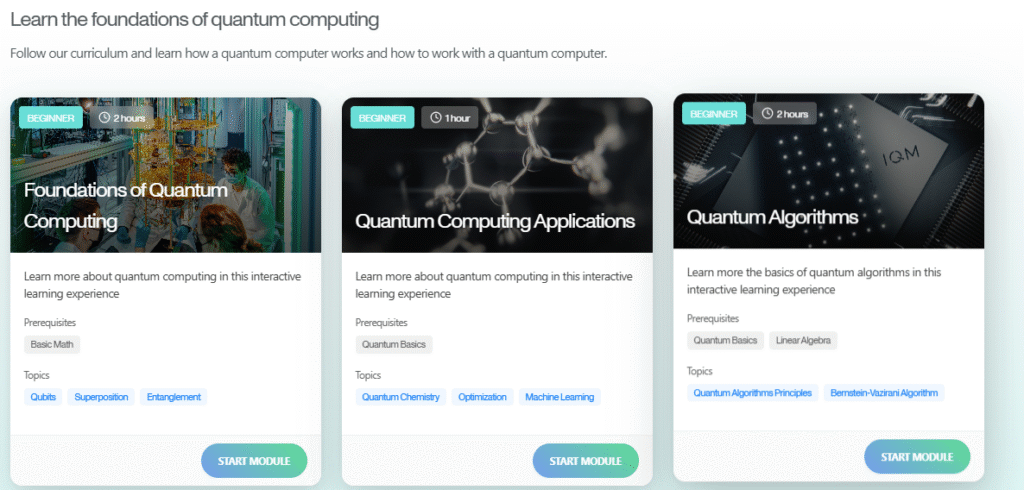
In an era where quantum computing is moving from theory to practical research and early commercialisation, platforms that guide learners from scratch to advanced topics become hugely valuable. One such platform is IQM Academy — which offers a structured, interactive way to learn quantum computing. Let’s explore its importance, standout features, and how you — whether a curious student, a researcher or a working professional — can benefit from it.
Why IQM Academy Matters
- Bridging the quantum knowledge gap
Quantum computing is still a niche area; many students or professionals may feel intimidated by the mathematics (linear algebra, Hilbert spaces) or by the lack of clear learning paths. IQM Academy provides an accessible, tiered curriculum: from “Foundations” through “Intermediate” to “Advanced” topics. This kind of scaffolding helps learners gradually build confidence — rather than jumping straight to algorithms or error correction without context. - Interactive and practical orientation
The modules are described as “interactive learning experiences” (e.g., “Foundations of Quantum Computing”, “Quantum Algorithms”, “Quantum Error Correction”) with clear time-estimates (2 hours, 3 hours, etc) and prerequisite listings. This practical design means learners know what to expect, and the interactive nature helps retention and engagement. - Aligns with real quantum hardware and programming
IQM Academy doesn’t just teach conceptual ideas — it includes modules like “Get started with Qrisp on IQM” (their quantum computing environment) and “Creating Quantum Circuits With Code”. This means you get exposure to writing quantum-circuit code, which is a big plus if you hope to apply quantum computing later or join quantum-tech teams. - Advanced modules for deeper study
For those already comfortable with basics, IQM Academy offers “Advanced” modules, e.g., “Quantum Error Correction”, “Identifying Errors on a Quantum Computer”. That means the platform can serve both beginners and more advanced learners — making it a one-stop place for a long learning journey. - Glossary and terminologies
The platform includes a glossary to help you lookup quantum jargon.
For students encountering terms like “superposition”, “entanglement”, “toric code”, a glossary reduces friction significantly.
How You Can Benefit From It
Here are specific ways you — whether you are a student, a research enthusiast, or a professional — can make the most of IQM Academy.
- If you’re a student (undergraduate or postgraduate):
Use the “Foundations” modules to cover the basics of qubits, superposition and entanglement. Then proceed to modules on quantum algorithms and applications. This gives you a quantum‐computing portfolio (the code exercises) on top of your standard studies — which can differentiate you for internships or research roles. - If you’re a working professional (software engineer, data scientist, etc.):
You may already know classical programming and mathematics. Use the intermediate “Creating Quantum Circuits With Code” and “Implementing Textbook Algorithms” modules to translate your skills into the quantum domain. This opens doors to quantum‐computing teams, research labs or early‐adopter companies that are exploring quantum applications (e.g., optimisation, machine learning, chemistry). - If you’re a researcher or educator:
The advanced modules (e.g., error correction) allow you to deepen your understanding and may help propose or interpret quantum-computing research. Also, you could integrate selected modules into classroom or workshop settings to uplift quantum‐literacy across your institution. - For lifelong learners / science enthusiasts:
Quantum computing is fascinating even if you’re not planning a career shift. IQM Academy gives a guided way to explore “what the buzz is about” — without needing to download complex simulators or read dense academic papers first.
Tips to Make Your Learning Journey Successful
- Start with the prerequisites: Many modules note prerequisites (e.g., basic math, Python, linear algebra) — ensure you’re comfortable before jumping in. Otherwise you risk getting lost or discouraged.
- Schedule regular time: Each module lists approximate hours (1 hour, 2 hours, 3 hours) which means you can plan your learning — e.g., one module per week or per weekend.
- Do the coding exercises: The value comes from doing, not just reading. The modules that involve circuit creation or programming are where you solidify learning.
- Use the glossary actively: Whenever you hit an unfamiliar term, pause and look it up — this builds your quantum vocabulary over time.
- Track your progression: Start with Foundations → Intermediate → Advanced — set goals and review what you’ve learned periodically.
- Apply what you learn: Even if small, try writing your own quantum circuit code, or reading a quantum-computing research paper and mapping its circuit to one you built, to reinforce practical understanding.
Quantum computing is set to transform multiple domains—from chemistry and materials science to cryptography and optimisation. Early movers who build solid foundational knowledge will be well-positioned in this emerging ecosystem.
IQM Academy stands out as a thoughtfully structured, interactive platform that makes quantum computing accessible, practical, and progressive. Whether you’re just curious about “what a qubit is”, or you’re aiming to build quantum circuits and understand error-correction, this platform gives you a clear path.
