

In the fast-evolving world of generative AI, one challenge has loomed large: how do you turn chatbots into doers? Not just answerers of questions—but agents that can take action, orchestrate multiple steps, integrate with external systems, and behave somewhat autonomously while still under human supervision.
On October 6, 2025, during its DevDay event, OpenAI introduced AgentKit — a toolset that’s intended to shift that paradigm. In simple terms, AgentKit is designed to let developers (and enterprises) build, deploy, and optimize “agentic” systems more reliably and with less friction than before.
Below, I’ll unpack exactly what AgentKit brings to the table, why it matters, and how it humanizes the journey from idea to working AI agent.
What AgentKit Offers: Putting All the Pieces Together
Before AgentKit, creating an AI agent meant stitching together tooling: orchestration, prompt logic, evaluation pipelines, connectors, versioning, front-end UIs—and even then the integration gaps were many. AgentKit aims to unify all of that.
Here are its core components and innovations:
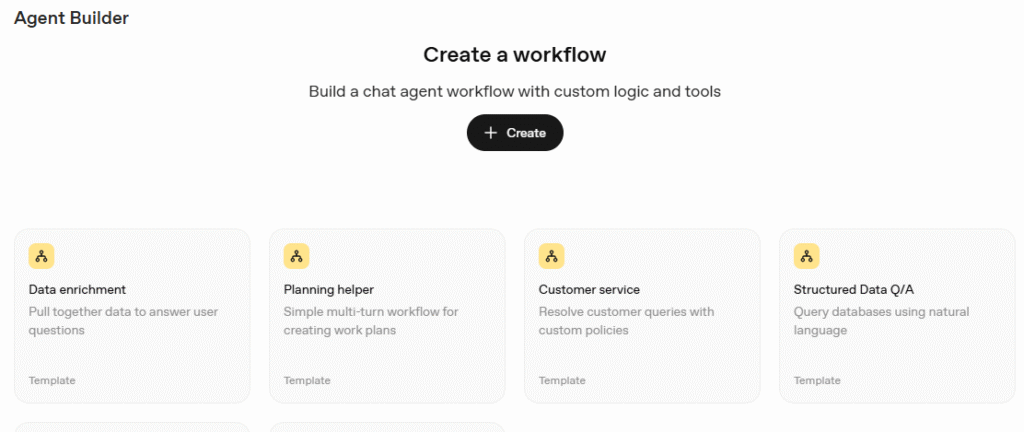
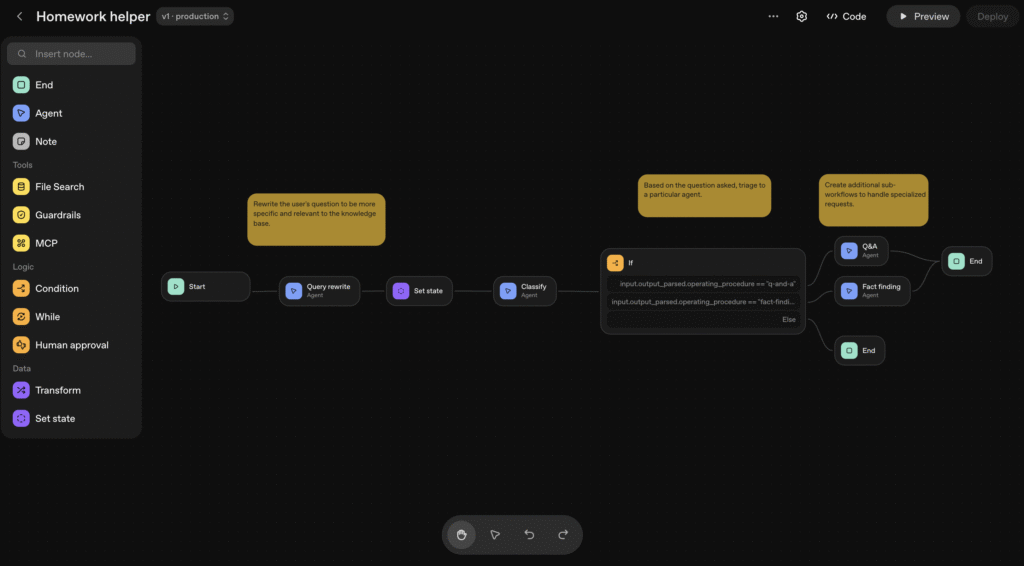
1. Agent Builder (Visual Workflow Design)
Imagine building a flowchart for how the agent should act—trigger, logic branch, tool invocation, decision, fallback—and do it with drag-and-drop. That’s Agent Builder. No more writing glue code from scratch.
It’s like giving non-engineers—product managers, domain experts—a canvas to tinker and prototype, bringing them closer into the loop alongside engineers.
2. ChatKit (Embed Agent UIs Easily)
An AI agent is more meaningful when it has a conversational interface. AgentKit provides a streamlined way to embed chat interfaces (with streaming, UI controls) so that agents can be surfaced in apps or web platforms without reinventing the wheel.
3. Built-in Connectors & Tools
Agents often need to talk to external systems—databases, APIs, internal business logic. AgentKit offers standardized connectors and support for third-party integrations, helping developers avoid glue code and brittle integrations.
4. Evals, Prompt Tuning & Version Control
You can’t just ship an agent and hope for the best. AgentKit introduces evaluation pipelines (datasets, grading, trace-based evaluation), prompt tuning loops, and version control for agent logic. This helps with accountability, iteration, and safety.
5. Reinforcement Fine-Tuning (RFT) for Agents
OpenAI is rolling out a new capability: Reinforcement Fine-Tuning targeted at agents. This means you can use reward signals and training loops to gradually improve agent behavior, especially for longer, multi-step tasks.
Why AgentKit Matters: What Changes, for Whom
For Developers
- Speed and iteration. What used to take months—wiring orchestration, frontend, connectors—can now be prototyped in weeks or even days. OpenAI claims huge reductions in iteration time.
- Less boilerplate, more focus. You don’t have to reinvent every piece. You can stand on top of a more opinionated stack.
- Better safety & observability. With versioning, evaluation, and monitoring built in, the risk of agents misbehaving is reduced (though never eliminated).
For Enterprise & Product Teams
- Democratization of agent design. More roles than just engineers can contribute to agent logic.
- Integration with business systems. Agents can become more than chat assistants—they can act within enterprise pipelines.
- Better ROI on AI. Instead of dead-end prototypes, you get a pathway toward deployable agent systems.
For Users (End-Customers)
- Smarter interfaces. Over time, you’ll interact with software that anticipates and acts—not just responds.
- Greater personalization & automation. Tasks like “plan my travel with constraints,” “adjust my schedule across tools,” or “prepare a report from multiple data sources” become more realistic.

How This Is Different
OpenAI has already experimented with agents:
- Operator: A research preview agent that could browse the web, click, scroll, and execute tasks like ordering or filling forms.
- ChatGPT Agent: A more advanced agent inside ChatGPT, merging “deep research” + web browsing + action capabilities.
- Agents SDK: OpenAI’s earlier public tools (in Python, JavaScript) for building agents with primitives.
AgentKit layers on top of all that. It’s not just an SDK—it’s a full stack: visual logic, evaluation, deployment, UI, and training loops. It bridges the experimental tools with a production mindset.
It also aims to compete with or complement existing automation/agent frameworks (like Microsoft AutoGen or Google’s agent tooling).

What This Means for AI enthusiast
As an AI enthusiast
- You can build localized agents (for local languages, regulatory domains, regional systems) faster.
- You can embed these agents in apps that your users already use (chat, SaaS tools, internal dashboards) without reinventing building blocks.
- You don’t have to start from scratch or invest huge engineering resources—AgentKit gives you a scaffold.
- You can compete globally: your agent logic might address local markets (payment systems, supply chains, local tools) but deliver global-grade experience.
Of course, you’ll need awareness around data sovereignty, compliance, and tailoring guardrails to your context.
Where OpenAI Might Go Next
AgentKit is a major step—but there are natural next frontiers:
- Stronger memory & personalization
Agents that understand you, adapt to preferences, and retain context (while preserving privacy) will heighten utility. - Cross-agent coordination & hierarchies
Agents supervising other agents, delegating tasks dynamically—think orchestration across multiple agents built with AgentKit. - Smarter reasoning & long-horizon planning
Handling multi-month projects, uncertainty, conditional branches, failure recovery. - Plug-and-play domain templates
Prebuilt, curated agent templates for domains (e.g. finance, HR, marketing) that teams can adapt. - Broad adoption of RFT / continuous learning
Allowing agents to improve in deployment from feedback loops, human correction, logging, safe reinforcement. - Stronger guardrails & interpretability
Improve explainability, audit trails, user-facing “why the agent took that action,” and safe exits.
AgentKit is not just a toolkit—it’s a statement: OpenAI is betting that agents (not static chat) are the next frontier of user experience and productivity. It’s an attempt to make agent-driven systems accessible, accountable, and deployable—not just an idea in research.
