
Imagine you ask an AI: “Who influenced Isaac Newton’s laws, and how?” A typical language model might try to piece together a response from isolated text snippets. But what if the system understood not just text, but a rich web of relationships — who taught whom, what discoveries led to what, how ideas influenced each other across time? That’s where GraphRAG comes in: it fuses traditional retrieval + generation with knowledge graphs to make reasoning more precise, structured, and explainable.
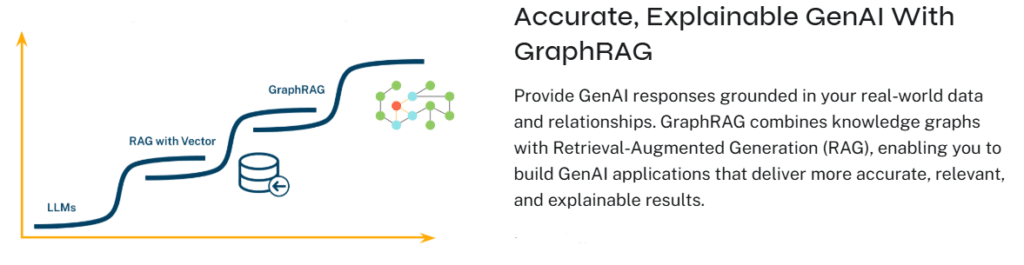
GraphRAG is essentially an evolution of the Retrieval-Augmented Generation (RAG) paradigm: instead of relying solely on vector similarity over text chunks, it introduces graph-structured knowledge (nodes, edges, relationships) into the retrieval and generation pipeline. This lets the system navigate and reason over relations, not just loose semantics.
Here’s how it works — in teacher-friendly terms — and why it might matter in educational settings.
Why GraphRAG? What Problems It Helps Solve
First, let’s see what limitations standard RAG approaches face, and how GraphRAG helps:
- Multi-hop reasoning: Many questions require going through chains of facts (“A influenced B, who in turn influenced C”). Traditional RAG may struggle to reliably link those chains. GraphRAG can traverse edges in a graph to connect those dots.
- Relational context understanding: Sometimes the relationship matters (e.g. “X mentored Y” vs “X influenced Y”). Graph structure explicitly encodes that.
- Explainability and traceability: With graph paths, you can inspect how the system arrived at a conclusion (which nodes and edges were used). That’s useful in educational or high-stakes scenarios.
- Domain specificity and structured data: In domains like science, history, or education, a graph can model curricula, concepts, prerequisites, authorship, etc. GraphRAG can leverage that structure.
GraphRAG enriches the “context” fed to the LLM with structural information, making reasoning more robust and interpretable.
The Core Components of GraphRAG (in simpler terms)
A GraphRAG pipeline typically has four conceptual parts:
- Query Processor
When a user (teacher, student, researcher) asks something, the system first parses the query to identify entities (persons, concepts) and relationships (e.g. “influenced by”, “authored”, “causes”). It then transforms that into graph-style queries (for example, representing “Newton” as a node, “influenced by” as an edge type).
This may use techniques like named entity recognition (NER) and relation extraction. - Retriever
Unlike a pure vector retriever that finds similar text chunks, the graph retriever navigates the knowledge graph. It may follow edges, perform graph traversal (breadth-first, depth-first), or use graph neural networks (GNNs).
It can look for subgraphs relevant to the query, not just isolated text. - Organizer
The retrieved subgraph may be messy or too large, with irrelevant nodes or tangents. The organizer prunes, reranks, and cleans the subgraph, retaining the key nodes and edges most relevant to the query. - Generator
The cleaned, structured information is passed to a language model which synthesizes a human-readable answer, possibly enriched with explanations or the reasoning path (e.g. “Newton ← was influenced by ← Hooke, etc.”).
GraphRAG crafts a mini knowledge graph tailored to a query, then asks the LLM to reason over it.
How GraphRAG Is Built Under the Hood
From an engineering perspective, here’s how one typically implements GraphRAG:
1. Indexing / Graph Construction
- Text segmentation: A large corpus (books, articles) is broken into manageable “text units” (paragraphs or sentences).
- Entity & relationship extraction: From each text unit, entities (e.g. “Newton”, “Hooke”) and relationships (“influenced by”, “wrote”) are extracted using LLMs or pipelines.
- Graph assembly: Entities become nodes, relationships become edges, and each text unit is tied to its relevant edges/nodes.
- Hierarchical clustering / community detection: To organize large graphs, you cluster nodes into communities or modules—helps retrieval scale better.
- Community summaries: For each cluster or community, high-level summaries are generated so queries can first consult a coarse view before zooming into details.
2. Query Handling: Local vs Global Search
- Global search involves consulting community summaries and reasoning over the structure of the graph at a higher level, useful for broad or exploratory questions.
- Local search focuses on particular entities and their neighbors to address more specific queries (e.g., “What textbooks did Newton use?”). This often uses a hybrid: first find candidate entities via vector similarity, then expand the graph around them.
3. Hybrid Retrieval and Reranking
GraphRAG often combines semantic retrieval (vector embeddings) and structural graph retrieval. The system might first find candidate nodes by embedding similarity, then validate or expand them via graph traversal, then rerank candidates based on both graph and semantic scores.
4. Answer Generation and Explanation
Finally, the system feeds the selected graph context into the LLM to generate a coherent answer. Because the context is structured, the model is more likely to stay on target, reduce hallucinations, and (if asked) produce a reasoning path or justification.
GraphRAG with Neo4j (and in Python)
Neo4j offers first-party support for GraphRAG via a Python package. This makes it easier for developers (or technically minded educators) to build GraphRAG pipelines with a graph database backend.
The package helps with storing graphs, querying via Cypher, integrating with LLMs, and managing hybrid retrieval. (Neo4j’s developer ecosystem also promotes combining vector and graph representations under one roof.)
In practice, one might:
- Load entities and relationships into Neo4j
- Index vector embeddings for nodes or text chunks
- Write Cypher queries that combine structural and semantic filters
- Use the GraphRAG Python library to handle the pipeline (retriever, organizer, generator)
(Neo4j has documentation for this in its “Neo4j GraphRAG for Python” offering.)
Applications in an Educational / Teaching Context
- Intelligent Tutoring & Question Answering
Suppose students ask rich questions like “How did the Enlightenment thinkers influence later political revolutions?” A GraphRAG system can trace relationships (e.g. philosophers → their works → influence on movements) and produce precise, structured answers. - Curriculum Mapping & Prerequisite Discovery
You could build a graph of curriculum topics (nodes = topics, edges = prerequisite relationships). Then a GraphRAG system could answer queries like “Which topics should a student already know before learning quantum mechanics?” or “Which concepts link calculus to differential equations?” - Research Assistants for Teachers and Students
For in-depth assignments or papers, students often have to navigate multiple sources and draw connections. A GraphRAG-powered assistant can help them by surfacing relationships across documents, suggesting paths of reasoning, and helping avoid spurious conclusions. - Automated Summarization & Synthesis
If you have a large reading corpus (say, a set of journal articles), GraphRAG can help create query-focused summaries, synthesizing the most relevant facts and relationships. - Explainable AI in the Classroom
The graph paths used for reasoning can be shown to learners, helping them see why the AI answered a particular way. This transparency can lead to helpful discussions about reasoning, bias, and trust.
Challenges & Considerations (Especially for Teachers)
GraphRAG is powerful, but not perfect. If you’re considering adopting it, keep in mind:
- Scalability: As the knowledge graph grows, indexing, traversal, and storage become more complex and resource intensive.
- Graph modeling choices: Deciding what kinds of nodes and edges to include (and at what granularity) is a critical design decision that affects usefulness.
- Error accumulation in multi-hop reasoning: Each hop (edge traversal) introduces chances for error or noise, which can cascade.
- Privacy & sensitive data: In educational settings, student data or assessments might be private. If that becomes part of the graph, you’ll need strong safeguards.
- Explainability vs. complexity: While graph structure helps, generating explanations that are both accurate + human-friendly is nontrivial.
- Knowledge poisoning and manipulation: Recent research warns that slight changes in input text can distort the graph structure and mislead reasoning — care must be taken to validate and sanitize inputs.
Practical Tips for Teachers / Educational Technologists Getting Started
- Start small & domain specific
Build a graph for a particular subject (say, a module in your syllabus). Populate relationships among key concepts, authors, works, etc. - Curate the graph
Don’t try to ingest entire textbooks automatically without supervision. Clean, curated relationships often yield better reasoning. - Use hybrid retrieval
Combine vector search (for semantics) with graph structure (for relationships). Don’t rely only on one approach. - Include human oversight
Especially in education, you (or subject experts) should review or validate generated answers before deployment. - Expose reasoning paths to students
Let learners see the nodes/edges the AI used. This can spark reflection, debate, and deeper learning. - Iterate & refine
As you see wrong answers or misconnections, refine the graph schema, relationships, or retriever thresholds.
GraphRAG is a compelling next step in the evolution of AI reasoning: by integrating the structure of knowledge (via graphs) with generative models, it becomes possible to answer more complex questions, provide transparency, and better reflect relational context.
For teachers and educational technologists, GraphRAG offers a path to more intelligent tutoring systems, research assistants, curriculum mapping, and tools that not only answer but explain. While implementation requires care — in graph design, scaling, and oversight — even modest early adopters can benefit by giving students and educators tools that reason more richly than plain text retrieval.
